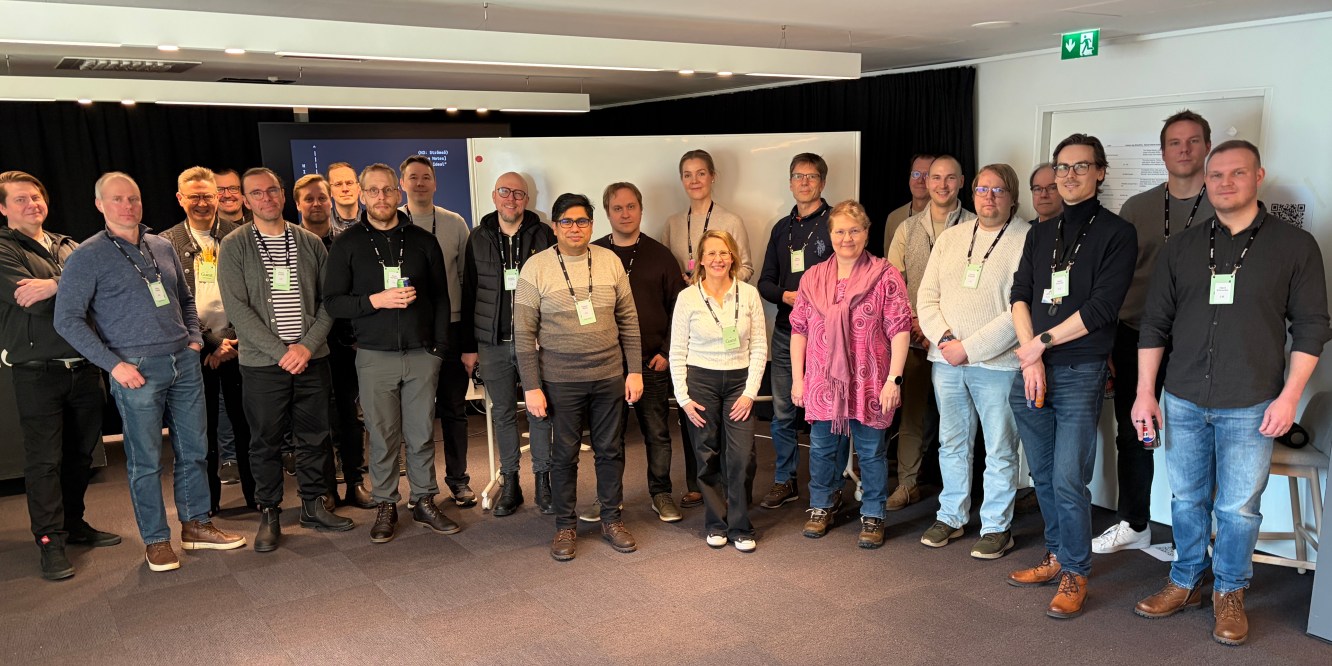
The use of AI in software development has highlighted the need for sharing learnings. The tools are evolving so rapidly that keeping up alone is nearly impossible. “The best knowledge is out there,” someone wise said to me a long time ago, referring to the fact that knowledge isn’t in one individual’s head, not in the team or even in the company you work for, but out there in networks. That is even more relevant today for keeping up with development.
In parallel, this time has emphasised the importance of sharing your thoughts with people around you, encouraging peers to experiment and adopt better practices. It’s everyday sharing, of course, but during the past six months, our live sessions have proven especially useful: one person prepares a story and demo about what they have learned, while others ask questions and share details. These types of clinics have existed for a long time, of course, but they are especially valuable now, with AI tools maturing so fast.
The first session like this was an AI Afternoon last fall, followed by a half‑hour AI hub session every three weeks with our teams from the Digital Identity and Interaction area at Elisa. The benefit of meeting in person is obvious: you can look someone in the eye and instantly see whether they understand you. Encouraging senior developers to share what they build and learn accelerates everyone’s progress. Together, we all move forward faster. We have a solid toolset for software development, GitHub Copilot is part of the workflow, with Claude and Codex being the most used at the moment. Choosing tools ultimately comes down to preference, taste and compatibility with the task.
Paying attention to the speed of learning
There are many ways to work efficiently with different tools. One successful approach is pair programming, with AI agents being “the third” member of the pair. This practice is good for preventing sloppiness on the developer side, said a very senior developer, because two pairs of eyes are looking at the code that the agent produced. Another successful way of embracing AI development is through senior‑driven hobby projects, where genuine passion for the topic drives the transformation into day‑to‑day work as well. A great example of the latter is Teemu Piirainen, whose experiments you can read more about in the Ask a Friend post and by following Teemu on LinkedIn.
After years of working in digital identity, data and AI, one thing stays the same: culture is the real enabler of transformation, also in AI. It’s not the tools. Not the tech. It’s the people. Culture is the core ingredient that enables everything else; it should allow and encourage people to test and experiment and spend time on new tools, because it pays back with efficiency, better practices and quality. Esko Kilpi taught years ago that optimising the speed of learning is the most important thing. That’s what the AI hubs and other sharing sessions are for.
Celebrating success
Last fall, we faced a demanding challenge: renewing a customer‑facing service platform with a highly complex backend and architecture. Before it started, we had revisited our original plan of replacing the old system with an app and returned to updating the old platform completely. We knew another team in another company had been working on the same platform renewal for quite some time before us. Under tight time pressure and the threat of possible sanctions, we completed the renewal in under a quarter, much faster than the other company, and went live on our first production tryout without having to roll back anything.
I’m telling this story because it’s very important to remember to celebrate our successes. It’s so easy to jump straight into the next interesting thing, because there are always plenty. However, we also need to pause and reflect on why it was a success and how we can replicate that approach next time.
In this case, the learnings were clear: get the best possible experts to build the solution. This meant building a virtual team, with developers from my other team joining forces with experts from another in‑house team and experts from the partner company. Then, use agile ways of working to support the whole circus, dailies, planning, refinements, retros, etc. Use AI to speed up the development process; in this case, pair programming with a Claude agent as the third member worked wonders. And get everyone who needs to be involved, developers and other subject experts, designers, PM, PO and relevant people from the business side, into the daily activities, so that blockers and problems are detected and solved fast. Also, the production go‑live was done on Saturday to avoid disturbance from other work or disturbance for customers and gave us two days to solve problems and the possibility to roll back if needed.
And then, remembering the “victory pulla”, in this case even a cake and some sparkling, to celebrate the success!
A long‑game perspective
Culture needs daily care. I try to join every team’s daily stand‑ups because those short 15‑minute meetings tell me how people are doing, who might be struggling and where support is needed. Culture grows through everyday contact, and it drifts quietly if no one pays attention. Culture can be sensed intuitively, but it also reveals itself in certain signals. A lack of kudos in retrospectives or chats, less peer‑to‑peer recognition and fewer offers to help are early signs of cultural erosion. In strong cultures, appreciation is constant, learning spreads organically, and teams doing exciting work naturally attract others. Culture evolves locally, within small communities, and spreads outward when those communities thrive.
Cultural change happens through people; peer‑to‑peer influence is powerful. Workshops with clear outcomes, communities and shared learning are not extras; they are the mechanisms by which culture becomes lived practice. Intuition about people matters in team building and recruitment. Sometimes, the best hires join when timing aligns years later, relationships and trust built along the way make that possible.
Ultimately, culture is a long‑term commitment. I believe it’s built through connection, curiosity, kindness, clear goals and shared responsibility. As a leader, you have to be demanding, but in a nice way. Technology evolves quickly, but people evolve through trust, support and a sense of belonging. A strong tech and AI culture enables innovation and wins, not because the tools are powerful, but because the people using them feel empowered and inspired.
Thanks for reading!
This blog post was inspired by the Evolution Exchange Finland Podcast hosted by Luke Vickers. Thank you, Olli Kilpeläinen, Mikko Muurinen and Janne Nikkola, for the interesting discussion about Tech & AI culture!

 Small experiments and inspiration