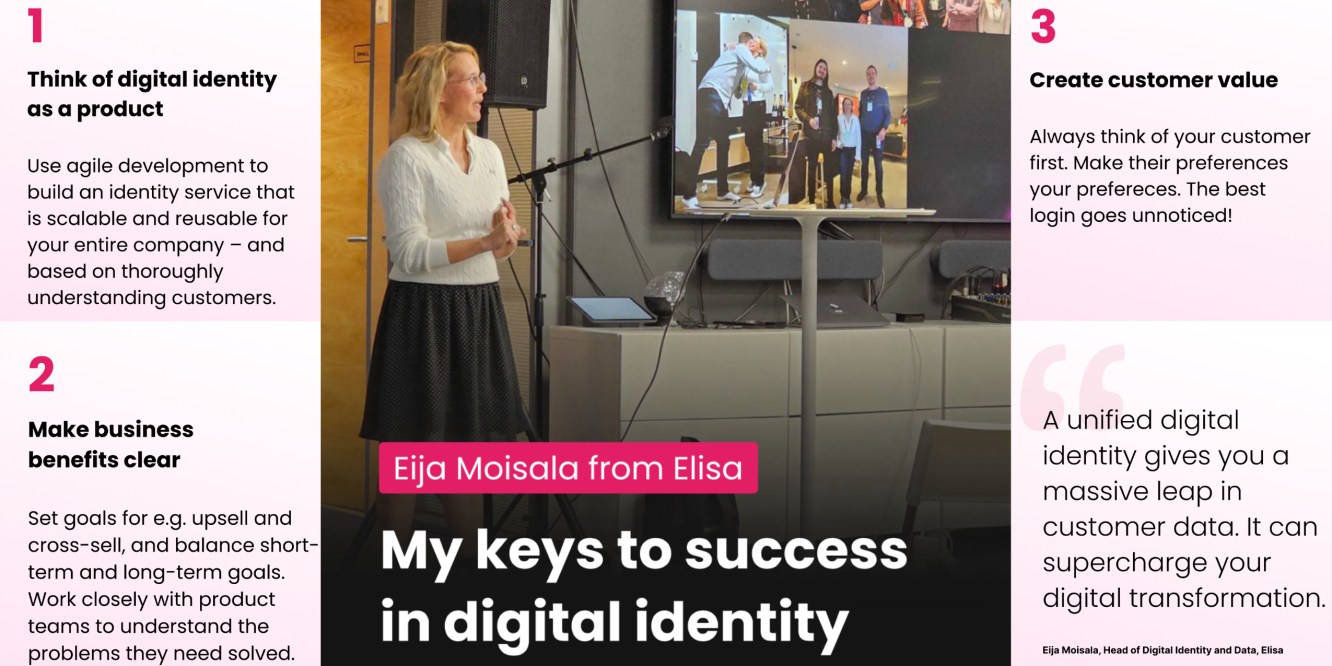
Qvik invited me to speak at their product management after-work event in August. I shared thoughts on digital identity and how developing it can be used as a tool for transformation. I focused on three areas: how to lead digital identity as a product, how to generate business value, and how to build better customer experiences.
There was a lively discussion throughout the presentation, which I really appreciated. People asked great questions:
How do you get management buy-in?
How do you involve stakeholders and product teams effectively?
And how do you secure proper funding for a project like this?
From the start, I knew that if a project of this scale, as Elisa‘s was going to be successful, it needed proper resourcing and commitment. In large companies that serve both B2B and B2C customers, the number of systems and services involved tends to be massive. Without a centralised team and aligned ways of working, you risk wasting years.
You need to understand what kind of game you’re signing up for. I’ve seen so many software development projects that felt like pushing a rope. I knew that unless the timing was right and the organisation was genuinely motivated to build something meaningful, it wouldn’t be worth it – or at least I wouldn’t be the right person to lead it.
You also need to listen very carefully to what problems stakeholders are actually trying to solve, and understand their goals and KPIs, in order to provide real value through the project.
Building with stakeholders
We did an extensive requirements discovery phase early on to ensure strong stakeholder involvement. Those same people have been providing valuable input throughout the journey. In this kind of renewal, it’s crucial to communicate progress and benefits regularly. Each business unit agreed to fund the development up front, so they need to see the value coming back.
We track and report both financial and customer impact, run demos, and share updates frequently across the organisation.
Treating Digital Identity as a product
Some great questions were raised around what it means to treat digital identity as a product. In a company with many services across both B2C and B2B, you have to productize your work to make it scalable and efficient.
We worked closely with the first implementation team – the OmaElisa self-service for customers – to get the foundation right. This included supporting multiple identifiers, custom features, and legacy systems. We created developer guidelines and shared ways of working to support all future teams adopting the new system.
We also standardised our collaboration models: same weekly/biweekly formats, same stakeholder engagement, so we don’t have to reinvent the wheel every time. The entire development has followed a clear process – from roadmapping, RFI/RFPs, and POCs, to detailed planning and phased implementation. The same approach applies to releases, testing, and go-lives – all staged and aligned with the broader service and product rollouts.
It all comes down to people
Once again, I emphasised how people are the most important part of the equation. Even if you get management buy-in, stakeholder involvement, and cross-team collaboration – in the end, it comes down to whether you have the right people to actually build the solution.
I’ve been incredibly lucky to work with such smart developers, designers and tech leads. We’ve invested a lot in team culture and development. I’ve written previously about culture workshops, ways of working, and how to build trust and joy in high-performing dev teams – check out my earlier blog posts if you’re interested in that side of the work.
It was a pleasure to have such an engaged audience and great conversations afterwards. So many of us are tackling similar challenges in digital development, and it’s always refreshing to hear how different companies are approaching them.
Thanks again to Qvik for having me!

 Small experiments and inspiration