Learnings: 1. It’s too early to predict the future of AI, 2. with AI you tend to focus too narrowly on the present, and 3. It’s not just the AI, you need to focus on multiple industries and innovations and the combinations can bring success.
I saw Amy Webb, a quantitative futurist and CEO of Future Today Institute, for the first time live on stage at South by Southwest SXSW in Austin in 2016. Her presentation about Tech Trends blew my mind. The beauty of combining years of thorough research work with insightful and sharp predictions of the futures was the best that I had ever seen. I had been following technology and media research for years already, but the way Amy Webb was able to leverage the work of her research team was completely something else.
One of the amazing things about this work was that Amy Webb was also sharing the insights for free with everyone. That means she open-sourced hundreds of categories of combined insights for other researchers and business people to use. I feel that it’s truly an act of wanting to make the world a better place for everyone.
I’ve been following Amy Webb’s work ever since, and also benefiting from the insights. Every year, after the SXSW in March, she also publishes a presentation of the Emerging Tech Trends on YouTube. The 16th edition of 2023 is pure open-sourced magic again.
This September I saw Amy Webb speaking at the Nordic Business Forum, and what a brilliant piece of work it was, even though it wasn’t about the tech trends. It was her first visit to Helsinki which also made it special. Webb’s topic was the Futures of Artificial Intelligence, and she started by explaining what AI, Large language models and generative AI mean. These methods have been in use for decades already, and LLMs are merely AI tools that ingest and generate information, nothing more than that. Of course, now that we have UI’s for everyone to explore AI, it’s more visible and tangible.
Regardless of the industry, says Amy Webb, there are generally two common mistakes that are made with AI. The first one is that it is too early to predict the future of AI. There are too many intersecting directions, which together form the futures. All of these elements should be taken into account when predicting the future of AI.
There is a lack of fundamental understanding, business people are expected to understand AI, which is insane, considering its complexity. However, according to Webb, managers often think they know what should be done. It is thought that AI can be learned by managers themselves and take a position on it.
AI has been developed over hundreds of years in different domains, and now most commonly managers and business people are talking only about generative AI. An easy user interface and getting to know AI is a good thing, but at the same time it’s easy to get blinded by what it’s about. For example, Webb explained what materials are behind the different versions of ChatGPT, and how it does affect the final result and its reliability. Amy Webb’s books are in the training set of GPT-4, but do we trust the training data as a whole, is the essential question.
AI is more about assistive computing than fancy robots, says Webb, and tools that we all have been using for decades, like calculators, just more training data behind the new tools. Amy Webb gives three examples of assistive computing. The first example is about the ability of conversational AI tools to digest and extract huge amounts of information, from cat pictures to complex information. This is great for people who want information fast, but bad for the media companies because consumers can get information without even going to media sites. Webb says that this will make the media unnecessary. That is of course hard to swallow for the media people. But it has implications on a larger scale as well, the whole internet as we use it will also be unnecessary. It’s the end of the internet as you know it, claims Webb.
The second example is about screenshots and the capability of extracting insights from any piece of content. We can use tools that automatically summarize information from pictures and texts and tell us what we need to know. Everything is going to be information. All is data, and in the near future, it will be mineable for the tools. It means that the information overload will decrease with the use of AI. It’s bad news for teachers since students can just use AI to summarize information.
The third example was about simple tools that can do basic work for you, like finding out ways to decrease your costs by just using your billing information. In this example, Webb was using Bard, a conversational AI tool by Google. It took only milliseconds for Bard to give cost reduction suggestions. That means that workers will need to learn how to delegate. These tools are good news for managers that can use AI tools. But bad news for small companies whose business model relies on billable hours on basic operations. AI is wonderful, but not magic, says Amy Webb.
AI tools are based on reinforcement learning with human feedback. It requires millions of people behind the tools and relying on third-party contributors. What do the audits and compliance look like? Asks Webb. Behind many of the tools there are for example Pakistani and Kenyan workers, and with humans it’s always subjective. Everyone, including myself, who has developed machine learning models and tools knows that the quality and probabilities of the teaching material are an essential part.
Amy Webb gives an example of using Midjourney to represent a picture of a CEO in a large hospital, and as expected, four white middle-aged or mature men appeared on the screen. The same goes with midsize and even for small hospitals, the fellows just get more handsome, and even with a hospital in town with the largest amount of females in the States. The results didn’t surprise me, but they didn’t make me laugh either. Also when asking what the CEO of a tampon factory looks like, it gives four pictures of senior white males. The bias from human feedback is visible in the last example since the pictures of the tampons with the CEOs are very strange objects that don’t look like tampons at all, which is, of course, the indication that male Pakistani workers don’t know what a tampon looks like. I think this is a very good example of the various kinds of biases in all AI tools, that one would need to be aware of when using. The same applies when building for example recommendation engines in streaming services in Finland with all male coders behind them, which I have first-hand experience with.
Coming back to the second common mistake that is made with AI is that people are rather narrowly focused on the present. The future will look completely different with new sectors involved. According to Amy Webb, there is the urge to think only about the near future. Most companies are focusing on 12 months or a maximum of 24 months when thinking about AI utilization. But that doesn’t grow the bottom line finance, says Webb. We would need to think about how to change our thinking in a broader way and use combined technology. Webb gives an example of a button device that records all speech, which can reflect the information for example to the palm of your hand. Most importantly the device records all the meetings you are in during the day and then makes a summary at the end of the day. It’s screenless with frictionless answers, straight from science to reality. The problem is that most of the companies don’t do combined technologies, they just iterate the current solutions, instead of innovating.
Amy Webb returns to this topic after her presentation on the big stage later in the afternoon on the HS vision stage. She gives an example of the future possibility of combining AI with bioenergy and with quantum algorithms. By researching and investigating all of these three areas and finding connections and future possibilities there might be something worthwhile to predict for business also. The results can only come with hard work of focusing on multiple areas, not just thinking about AI and what it brings to the business.
For me, the Tech Trends are all about these combinations and broadening your horizons. They are also about human rights, diversity, equity and inclusion, environmental sustainability, and the beauty of enhancing all of these areas with technology and AI. Of course always keep in mind the gloomy possible futures as well, which in many of the cases are much more likely to arrive than the positive ones.
In my mind, it’s also about understanding the fact that wisdom isn’t in one person’s mind, or in one team’s thinking, or in a single company, but that it’s out there in the world. You need to combine your thoughts with other brilliant thinking and then it can evolve to be something extraordinary. It’s also the idea of a honeypot, when you share something brilliant openly with others, people will want to join you in what you’re doing, resulting in something even bettert. I’m a firm supporter of this ideology, even though I’m not sure if Webb thinks so.
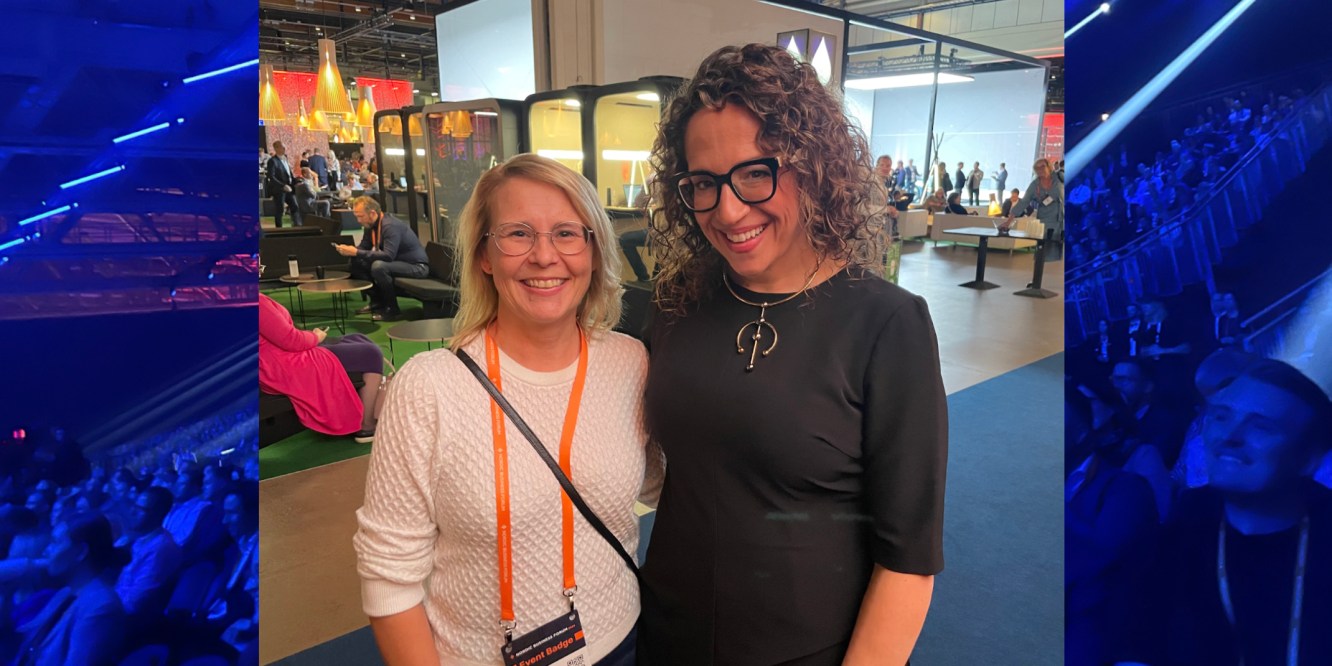
Well, if you have been reading this far, you know that seeing Amy Webb on stage is always a fan moment for me. But the true fangirl moment was after the NBF interview on the HS Visio stage because I was able to meet her in person for a few minutes. I could tell her how much I appreciated her work and got to take a picture of us. I don’t think that meeting any other celebrity, rockstar or politician could have made me happier. I was on cloud nine for days after. So that was it, me meeting Amy Webb! Don’t underestimate the power of live meetings, live music, and the beauty of people connecting and sharing in person. Thank you NBF for being an awesome event again, and for enhancing the experience for Amy Webb by changing the music to fit her taste with Rage Against the Machine when entering the stage. Of course, NBF ❤ CX.
Thanks for reading, have an insightful fall!

 Small experiments and inspiration