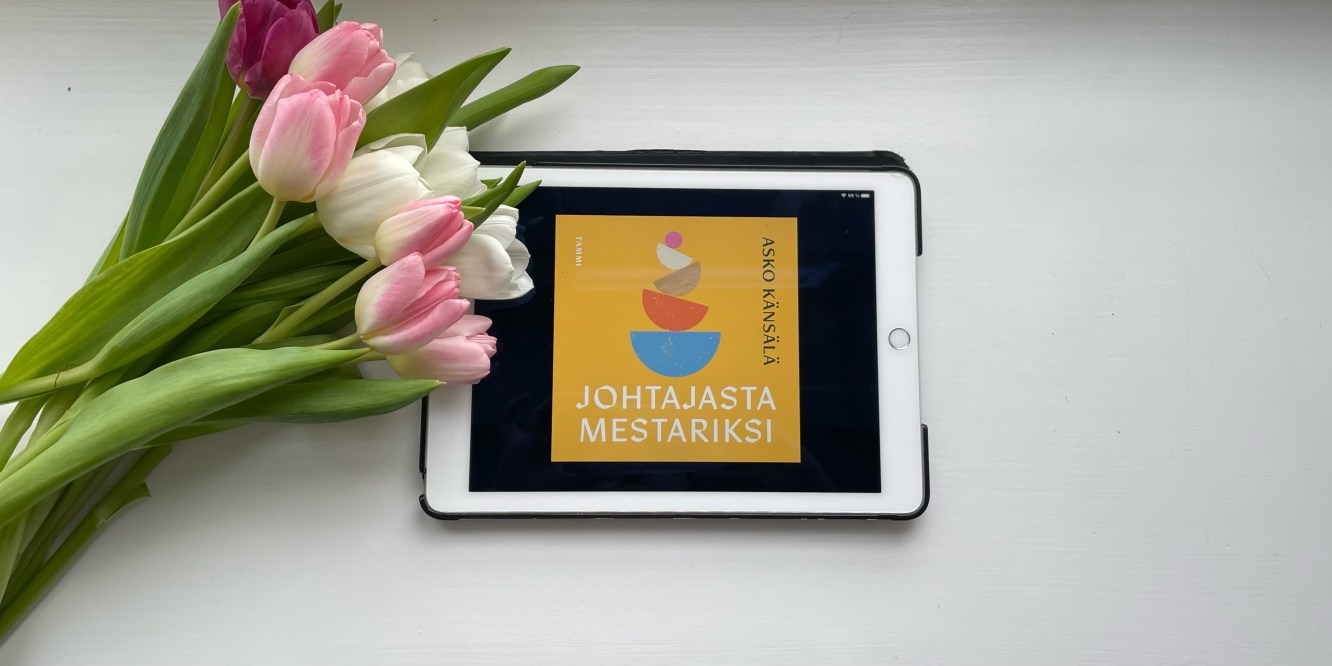
Johtajasta mestariksi (From Leader to Champion) by Asko Känsälä is not a typical business book because it emphasizes the importance of long-span thinking and long-term business development. I may have read more start-up books recently, but still, it feels appealing, that this book underlines the significance of experience over short-term wins. The author uses eloquently a multidisciplinary approach, which combines technology, art and human-centeredness from different decades.
My positive reader experience may be affected by the fact that I also work at Elisa, where the author was working for 17 years, even though I came to the company after he had left. However, I believe I’ve seen in action a lot of the company culture he describes in the book. Customer focus, humility in doing things, and continuous learning are things that all organizations would benefit from emphasizing.
The essence of leadership is an interest in people, Känsälä writes, “I didn’t feel like a leader, but I have been lucky and privileged to be able to do challenging work together with talented colleagues”. Also, a positive perception of people is important. The author sees other people as trustworthy and interesting. This is also how he thinks about himself, and his personality reflects the perception of people, he writes. It’s about the importance of knowing yourself, knowing your strengths, and also the weaknesses that you can develop. This self-knowledge also involves finding one’s own identity, he writes.
Känsälä writes about improving self-awareness and about his values: Strong will “If there is a will there is a way”, responsibility “walk your talk”, creativity “break it and make it”, and compassion “from human to human”. Käsälä describes work as comprehensive, involving the head, hand and heart. He emphasises the attitude of development, peace of mind and balance. He also writes about the importance of family and being meaningful and loved no matter what happens in work life.
The importance of knowing yourself is so true. When I decided to leave a company I had worked for many years, I knew right away that I had the courage to jump into something new. But to figure out what I wanted to do I needed a lot of thinking and testing my thoughts with friends, mentors and possible employers. I understood my strengths and weaknesses better and what I wanted to do most passionately. This time of deep self-reflection has enabled great satisfaction in the current work.
Throughout the book, Känsälä describes his thinking models and what experiences have affected his thinking, like the time he lived in Japan. He points out the importance of taking time for thinking in general. “Better thinking leads to better results”, he believes. That means avoiding the rush. If you are in a hurry, you have to change things so that you have time to think. Creating a rush is leading with fear, he writes. The idealization of speed leads to making bad decisions in a hurry. When I compare this to other companies I’ve worked with I think Elisa has quite the right balance between rush and time to think.
“Uncertainty creates certainty”, says Känsälä. You should learn to like uncertainty because it is useful. It is the willingness to tolerate leaving things open, and it’s listening and dialogue. Uncertainty is a leader’s good friend, it creates humility and gives visibility to one’s own path. I guess Känsälä’s tolerance of uncertainty comes also from his boss because he praises Veli-Matti Mattila for good leadership, trust and challenge. He writes that he was always supportive, even if things failed.
Känsälä writes cleverly about team efforts, and that everything depends on the team’s success and on joint learning. He explains that when it comes to learning it helped the most to increase: 1. Diversity, 2. Trust, 3. Inclusion, 4. Effectiveness, 5. Humour. The list is wonderful, I think very much the same way. How perfectly encapsulated is the recipe for every successful team!
The author opens the list up by explaining the importance of a multi-background and multi-perspective approach so that everyone dares to bring up perspectives from their own background. It requires plenty of time to build trust among the team members. It is essential to have a discussion and mutual cooperation instead of competition. Everyone needs to be involved in decision-making, and not just the voices of the loudest. And because success creates motivation, it’s good to repeat achievements from time to time. But not to forget humour, laughter is important so that there is room for broad thinking.
Diversity is not that visible though in his examples of crafts and activities, since he, for example, tells in detail about woodworking and tools, shooting, and sports which are typically more male-oriented. While listening to the very many details, it made me smile to think what if he had told me just as passionately about knitting a sweater or some other not-so-cool thing. Women and men often look at things through slightly different lenses, and this is reflected in this book.
What is delightful is that Känsälä focuses very much on the customers in his book. He explains that customer value can be financial, functional, emotional or symbolic. It can be easiness, speed, a sense of security or monetary benefits. The importance is that the benefits are suitable to the customer’s own identity. The author writes about value promises and customer-first thinking. There can easily be a gap between the value proposition and everyday work. In his work it meant shortening the gap by taking small steps every day for the benefit of the customer, starting with customer service. Customer service is a mirror of the company’s quality, he writes.
Känsälä points out that to understand the customers better you need more than interviews and questionnaires. He tells stories about ethnographic research, front-line first thinking in store surroundings and the use of customer metrics for example NPS and utilizing open-ended answers from it, and generating deeper interviews based on them. He writes that you have to love your customer. Of course, this touches my heart, since I have been previously leading data and customer insight teams for years, and have seen its huge benefit for services and products.
One of Känsäläs leading thinking models is adaptability. A long-lived company needs vision, focus and constant adaptation to the changing world. It means continuous adaptation through doing and learning. He talks about the strategic learning cycle of insight, focus, alignment, execution, and renewal. No quick wins, but continuous learning. Getting used to small changes all the time also helps to cope with surprising changes, such as now the corona, Russia’s attack on Ukraine and the energy crisis.
Känsälä also writes about a culture of experimentation, which for me is of course meaningful while having a blog about experiments and working many years to improve experimentation cultures with different companies. Känsälä explains that at Elisa they started investing in experiments in order to find new business. Sometimes something learned while experimenting came into use in a completely different environment, as in his example about Elisa Viihde and Epic tv showed. Pivoting brings up lots of new business know-how. Känsälä writes about using Kata-method, self-directed teams, etc. and tutors for support. He finds it to be very beneficial that the management teams are among the first to learn new practices.
Känsälä ends his book gracefully by saying that there is a good reason to constantly expose yourself to evaluation, with your heart bravely involved. “Good leadership is the art of doing and not doing, giving space to others.” With all of the learnings the end result is a good life and beautiful company, he says.
Asko Känsälä. Johtajasta mestariksi. Tammi 2023.
Can be bought from Elisa Kirja

 Small experiments and inspiration