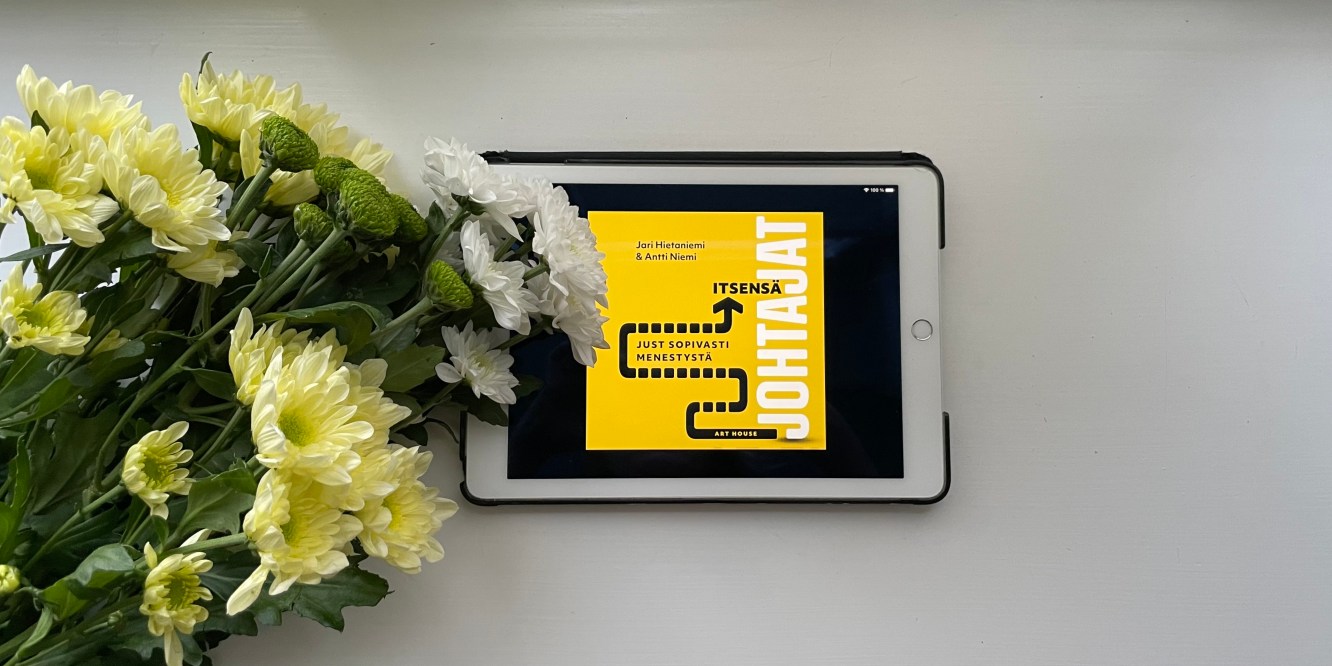
Success is more than financial success, and leadership is also self-management outside of managers, starts Jari Hietaniemi’s and Antti Niemi’s new book Itsensä johtajat, Just sopivasti menestystä (Self-leadership, Just the right amount of success). Traditionally, accomplishing things has been a measure of success. Throughout the whole book, Hietaniemi and Niemi focus on searching for what success means to individuals themselves. The book presents tools and practices from agile methods and design thinking, and Hietaniemi and Niemi have also interviewed six successful people from different domains for the book.
Success and happiness are two very different creatures. Happiness cannot be modelled, because it also needs some luck, Hietaniemi and Niemi say. Success doesn’t feel fulfilling if you don’t appreciate what you’ve achieved. This resonates with me, it’s not about what is commonly thought of as success, it’s how you view it yourself. That’s why you need to understand what success means to you, and what motivates you.
Thinking of what success means, it’s often at the same time a search for meaning and direction. The need for meaning is often sought from work, the book says, and I recognize it too. The well-known Ikigai is explained in the book and also talked about by a few of the interviewees. First, it’s about self-knowledge, what you are good at? What do you love, and what you would like to be better at? Then, what the world and others need, which is more challenging for many. Is there a problem that is bothering you? And finally, what would someone be willing to pay for?
I have also done the Ikigai exercise at turning points in my life. The first time was ten years ago when Antti Kirjavainen used it in Management 3.0 training, which I still remember fondly. It’s a good exercise for uncertain points or when having anxiety about your direction, but also easy to use from time to time in the status quo.
Hietaniemi and Niemi write elegantly that success is learning new things, and success is helping others to succeed. It needs both persistence and celebration of small achievements. Hietaniemi and Niemi emphasise the perspective of individual development, building your self-awareness, and goals towards success. First interviewee Timo Lappi talks more from the business perspective, what is behind the success of the companies in his career, especially Heltti.
I liked that the interviewees are from different business areas, even though software services and sports are a bit more common. Satu Rämö’s thoughts made the most impact on me since I have been a fan of her books for many years, especially her books about entrepreneurship. According to Rämö, movement is more important than direction. When you try something new, you will find out if the direction was right. However, prudence can sometimes prevent you from trying new things, and there is a danger that caution overtakes the way you operate when getting older.
For Rämö achieving small goals with precise plans is the thing, for example when writing a book, writing two pages per day. She is goal-oriented and for her, it’s a cosy place to pursue new things. It’s not ungratefulness about how things are but a way to produce peace of mind. I recognize this well. Rämö also feels at ease when talking about money. A business that does not make money is not worth it. You can have hobbies and do volunteering, but for work, a skilled person knows his/her worth and bills for it. Self-knowledge in wider respect is the key also in creative work.
Rämö talks about the importance of networks, listening and helping others. Be interested in others and sincerely strive to provide value to others. You also need to be excited on an emotional level about what you are doing, says Rämö, when striving for success.
Hietaniemi and Niemi write about building resilience and preparing for changing situations both in business and in life. In the book, there is quite a lot about stress management, which I don’t feel I need that much right now, but of course, they are useful skills at times. The resetting and restoring breathing exercises may not be exactly for me, but as the whole book encourages, it’s about increasing self-knowledge in the way that suits you. I still have a long way to go with meditations, even though many friends have recommended them along the way.
Anne Karilahti, a coaching professional and entrepreneur, also talks about setting goals and training oneself. New beginnings work for Karilahti and inspire her to do. She talks about writing books in work packages or chapters like Rämö. Internally the motivations are still very different, Karilahti is a starter and Rämö is a finisher. Karilahti says that the life of your dreams is not far away. The key is the ability to lead oneself, and not to live according to the wishes of others.
Like in their first book Just sopivasti ketterä (The just right amout of Agile), Hietaniemi and Niemi manage to package familiar tools in an interesting way. Reminders of best tools and practices are always in place so that you don’t just rush ahead in busy everyday life. OKR (Objectives and Key Results) is one of them and the fact that a maximum of three goals can be promoted at the same time. This limitation of goals is important in my opinion, no matter what the tool is. Companies have a tendency to pile on goals that please all different parties, and the palette easily swells way too big. I bet the same can happen with personal goals as well.
Flexibility in working, which is mentioned frequently in the book, appeals to me a lot. It’s wonderful that for example with using a part-time week, many acquaintances have founded their own companies in completely different areas and at the same time have kept their grip on the old familiar work. It’s great that even large companies see that flexibility brings learnings and know-how to the employee, which also benefits the company itself.
There are plenty of unifying factors in the stories of the book such as agility, quick experimentations and feedback loops, and the fact that you shouldn’t drag things out for too long with perfectionism. Life is never done. Things are not final either, bad choices may be included as well. New opportunities take time to develop but are rewarding in the end. Collaborate and look for opportunities in cooperation. Build a network and experiment together with someone, just start the conversation. I’ve had the pleasure of knowing and working with Antti Niemi during the last decade already, just starting from a conversation a lot of things can be achieved with him as proven by this book.
Hietaniemi and Niemi end the book beautifully by saying: When you truly dare to pursue a good life for yourself, you create a good life around you.
Itsensä johtajat. Just sopivasti menestystä. 2022.
(Self-leadership, Just the right amount of success. 2022.)
Can be bought in Finnish arthouse.fi

 Small experiments and inspiration