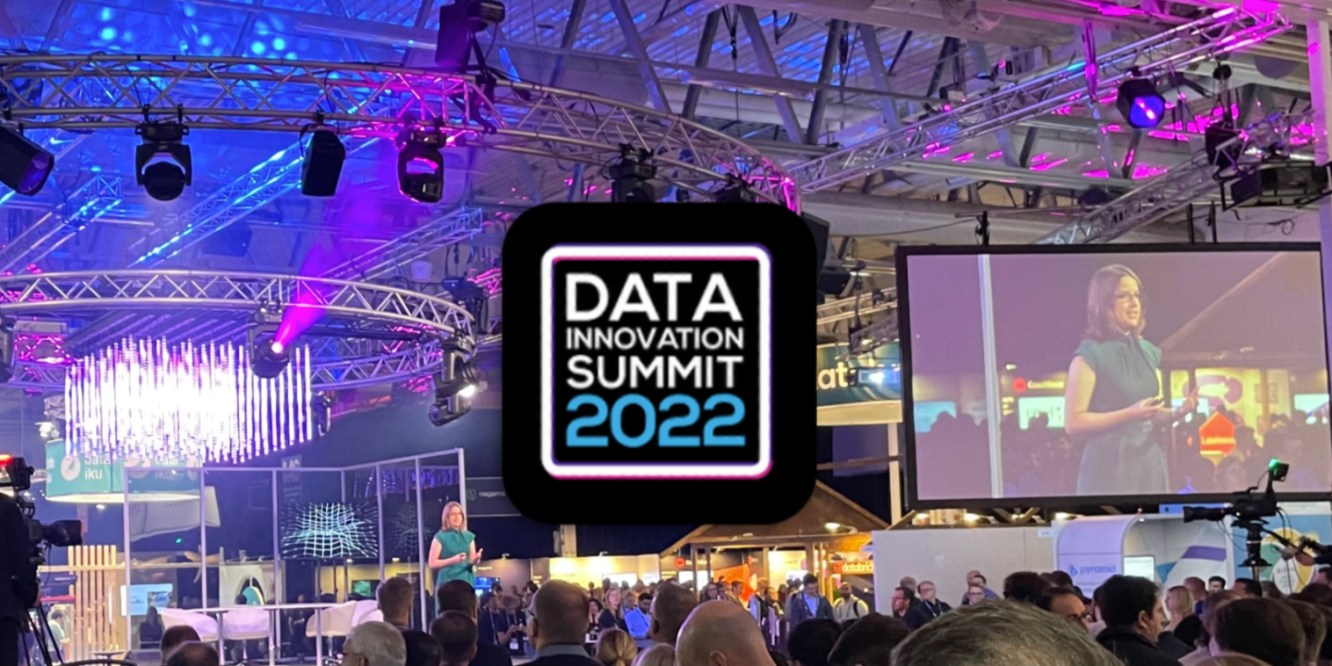
Data Innovation Summit 2022 had inspiring talks about building better data cultures, evolving from centralised data teams to cooperation models, and utilizing innovative technologies and tools. For me, the Summit was also about the joy of seeing data experts in the same place. There were over 2100 participants at the event, with over 1800 present in Stockholm on the 5th and 6th of May. It was the first big event I had participated in after the pandemia restrictions, and it felt great to be able to have live conversations about data, both jokes and professional pondering.
A lot of data tools, new solutions and tech companies were present in 8 different stages from the Data management stage to the Machine and deep learning stage, covering a variety of industries and different domains. Companies were from all over the world but there was also a good selection of Swedish origins consumer businesses with interesting stories such as Spotify, H&M and Telia.
Spotify’s Anders Nyman presented their data journey from one central team to data infrastructure, and to the age of feature teams, which they have been in for some years already. Age of feature teams means relying on several other teams than just your own when building ML features, which of course means a lot of dependencies. Spotify has created quality certifiers for the data coming from different teams and is using tools for ensuring the golden dataset. But it’s of course the people and cooperation that define the game. Data cultures were a big topic in general at the Summit, as were data mesh and data catalogues. Data mesh felt somewhat over presented, a bit like the fancy topic of the day.
H&M had a couple of presentations, Misbah Uddin and Md Tahseen Anam explained how they had been rolling out a data science platform as a product. They explained the data culture side nicely that it’s about enabling different personas to build AI solutions. Some work in low-code environments (like Dataiku), some in notebook environments with rich libraries and visualisations for reporting (like Databricks) and others with expert knowledge and diverse skills in cloud environments (like Google cloud). Reference architecture and standardization are needed to develop and deploy use cases, and a lot of training with the teams for building best practices.
Telia‘s cloud transformation presentation was entertaining with human pulse metrics from the journey. In 2020 started the building of a serverless data lake in AWS cloud, security and compliance work and also intensive training. Last year first use case came live, and the building of the AI/ML platform started. Josefine Boqvist, whose pulse was on the line, emphasised the importance of cooperation with a consultancy company and the technology provider in the whole process. Telia also told at the Summit that they have 350 data analytics experts of their own and that they are planning on hiring 100 more this year.
Interesting was also the Finnish Posti presentation by Riku Tapper, who explained that Posti has taken a value-driven and use case based approach to renewing its data capabilities. Tapper showed some of these use cases and I found intriguing the parcel routing and locker capacity forecasting. For predicting the future number of free lockers they are using details from lockers, senders and recipients, as also time and date etc. Personalized information of the sender and recipient is used in the predictions, even though individual data is not used as such. Posti was refreshing also in that sense that Tapper told what is still missing and under construction, for example, the data ownership is not acted on and architecture is dispersed. Looking forward to hearing more of Posti’s developments in the future.
Iiris Lahti from AI Roots, whom I’ve had the pleasure of collaborating with for many years, presented how to build a winning data team. The number of external consultants used in data teams is increasing, half of the Finnish companies have 20-50% of their data resourcing with external consultants, and a quarter of firms have more consultants than their own data people. Third of Finnish companies have a centralised data team and over half have a hybrid model, with both centralised and within business units. Lahti explained that a winning data team has several qualities for example strategic role and focus, it celebrates diversity in many ways such as skills, technology and gender, and it manages data as a service.
Interesting was also Greenpeace’s Ibrahim Elawadi presented 9 points of modern data stack in 2025. The transformation includes the rise of data mesh, the scaling of data governance and security, the necessity of data culture, and the growth of open source solutions, to name a few of his points. Similarly, Zalando’s Max Schultze had cleverly put together 10 Do’s and Don’t of Data Mesh, starting with demystifying the buzzword itself. He pointed out the importance of starting small, but with commitment, applying product thinking over platform development, and remembering not to create a platform with central data responsibility.
The Summit was very inspiring in many ways. For me personally, the nomination to the Nordic 100 Data, Analytics and AI – a list by Hyperight was a surprise and a very pleasant thing with promotion during the Summit. Here is another blog of mine about the Nordic 100 list. Thanks to Hyperight’s Goran Cvetanovski and Saranda Arifi and the whole team for the great event!

 Small experiments and inspiration
One Reply to “Inspirations from the Data Innovation Summit 2022”