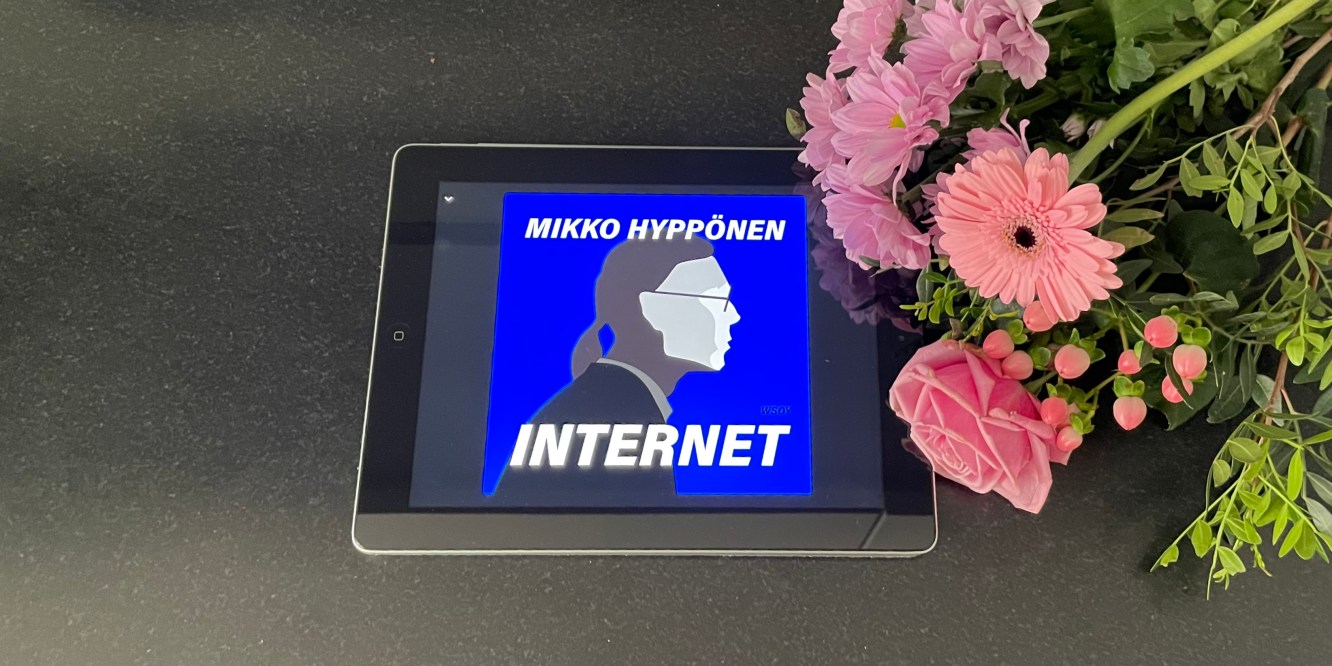
History goes hand in hand with the present in Internet, an interesting book written by Mikko Hyppönen. The book catches on from the start. Hyppönen writes about several paths in the history of the internet, such as the creation of web pages, the importance of Linux, and the power of data. However, he is likely to focus most on viruses, ransomware and other malware, and cyber security in general. Many things are worthwhile knowing for wider audiences as well, than just for people interested in the topic.
Hyppönen states through many practical examples that man is the weakest link in the equation when it comes to security threats. Scams are cunning and a person can be cheated. “If something seems too good to be true, it’s not true. Especially online”, Hyppönen states succinctly and gives an example of cheating in boat selling.
Hyppönen points out, that behind multiple great innovations, there are simple ideas or ideas that seem very obvious. The blockchain is one of those, he says, and it sounds almost too simple to work, but it does. There is complex math behind the simple idea, and as a result, blockchain technologies are been used worldwide in many different areas. Hyppönen claims that it’s when people understand themselves the solutions, changes are made.
Knowledge is power, knowledge is money, and knowledge is like uranium, he says. “Uranium is very valuable and dangerous, almost like data.” Hyppönen explains in detail about the psychotherapy centre Vastaamo case and also the use of Bitcoins in it, or should I say the attempt to use them for a big ransom. Bitcoin protects its users, even when it is a fraudulent attempt, writes Hyppönen. Privacy is dead, he continues later in the book.
Coming back to the simple ideas, I fully agree, one of the most efficient change-maker in the media context was bringing age and gender modelling in 2016 on top of the generic analytics data. The results were very easy to understand because it was just a simple idea of predicting how old the users were. I started the work with the point to prove that online audiences and traditional media audiences are very similar if we don’t change what we are offering to them. Of course, there was math and machine learning behind it, but the idea was really easy to understand and also to see the changes in the real-time results of media consumption when transforming everyday work. Simple ideas are behind many changes like Hyppönen says.
Hyppönen’s book is one of those books, that you feel sorry for its ending already at 80 % because of the flowing storytelling and interesting topics. I was listening to it from Bookbeat but noticed that I couldn’t listen to it in the late evenings because I wouldn’t fall asleep, but would pick up to listen. At the same time, the book is teeming with what I feel to be male examples such as war references, Tesla’s acceleration races and Hyppönen’s own glow about appearances at various conferences and with the media attention he has received. Still, it’s entertaining to read and pays due attention to cybersecurity.
The power of the tech giants is clear in Hyppönen’s book as well, as in Ritva Leino’s book I wrote a book review about earlier and writings that she has made in the past year for example in Suomen Kuvalehti. Hyppönen also paints a comprehensive picture about the Finnish influence in tech know-how with multiple companies and individuals, even though he keeps the international perspective the main flow the whole time.
Hyppönen begins and ends his book by stating that: “The Internet is the best and worst thing that has ever happened to us.” And he goes on to say that it has probably brought us more good than evil. And that he can’t wait for the next revolution it will bring us. Hyppönen’s book is definitely worth reading.
Mikko Hyppönen: Internet. WSOY. 2021 (In Finnish)

 Small experiments and inspiration