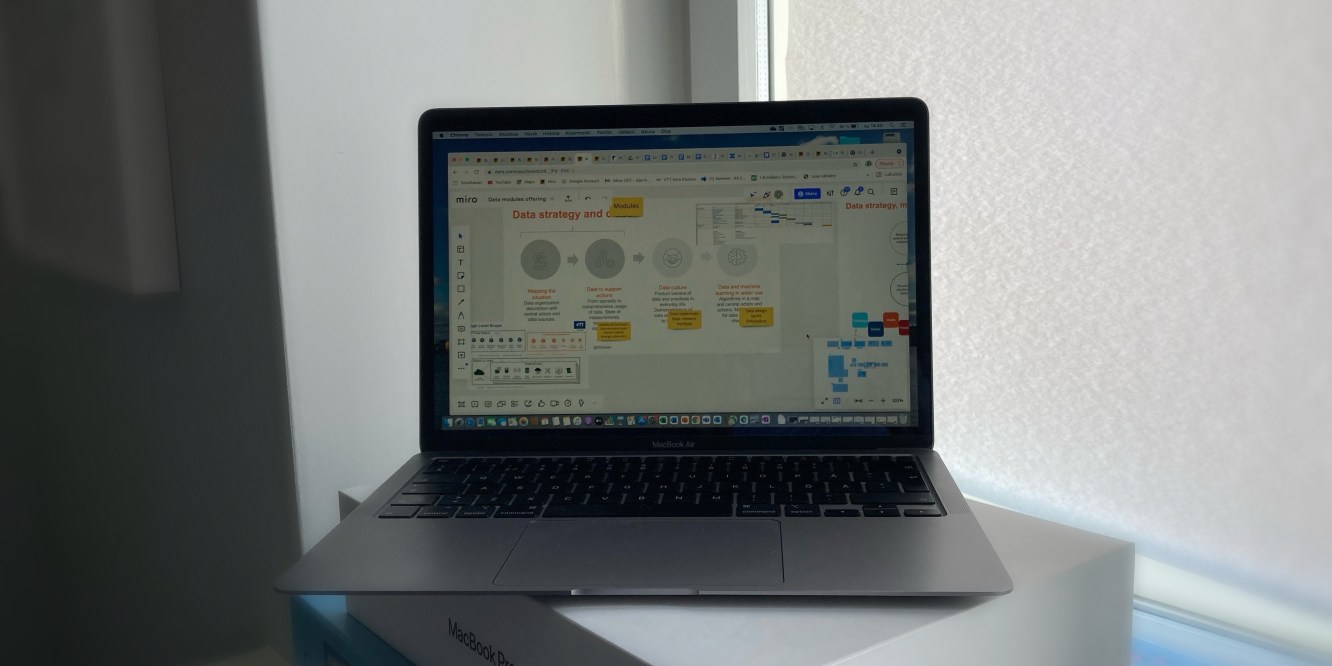
Data strategy development and implementation can range from a company level effort to a use case approach. Why do I enjoy doing data strategies from a use case point of view? I prefer use case approach, because it brings people together with concrete ideas for solving their everyday life problems.
It’s exciting to hear developers and other brilliant minds coming up with solutions in a facilitated and systematic way. Data is everywhere and that’s why it’s good to narrow down the scope with use cases. Otherwise, you might have a too wide perspective, and you end up solving nobody’s problems.
A data strategy is built for utilizing data assets in an efficient way and for accumulating a clear roadmap. It’s made to involve people in sharing ways of working and lessons learned. The goal is to help people to do their work easier, faster and in a more transparent way. At its best, as a result of the data strategy, the roles become clearer, new roles like data product owners emerge and the whole data culture with shared understanding, practices and tools is built.
There are many ways for carrying out data strategy execution, but a simplified version can be divided into four stages. In the first stage, mapping of the situation or a current state analysis is carried out. The purpose is not to map all the data work done in the company, but to start from the needs and most central things from the use case point of view. The benefits of the existing data solutions are brought to light. Current data architecture, data sources and central actors are defined.
The second stage is dedicated to finding out how data can support the actions of the company. The requirements from different stakeholders are defined. It includes mapping company goals and business needs tied to data and to the use cases particularly. This phase involves outlining best practices from technical, legal, governance and IT’s perspectives. It’s important to think about the impact people building the data strategy aim to produce, whether it’s for example influencing the actions and goals, creating visualizations, tools and algorithms or all of them. The first prioritization of features needed to be built is done at this stage.
The third stage is then bringing the data strategy alive by creating a shared data culture, ways of working and starting hands-on development for example with architecture and coding features. At this stage, common technologies and features, and on the other hand area-specific features are identified, connections figured out deeper and joint development decided. Business interests should guide the use cases and the prioritization of features. Otherwise, it can be easy to slip into over-planning or be buried under a large number of technological possibilities. Latest at this point funding becomes a very essential part. Business value creation needs to be close to the actual work, otherwise, the development easily will end before it properly even started.
Expanding the benefits of data and machine learning are at the core of the fourth stage. Depending on the goals it can be for example building better algorithms, recommendations or digital twins. Evaluating the possibilities of data ecosystems, data sharing and monetization of data comes also in this stage. With data, the variety of directions and business benefits are great.
All of these stages influence each other and a short feedback loop is needed. Balancing with easy to explain and complexity is important. The first use cases should be bold and tangible enough so that they can show real-life benefits. Use cases should also be complex enough so that you are able to scale from them to other use cases. It’s important not to try to solve all the problems at the same time, but to prioritize only a couple to be solved at once. Quick practical experiments with different teams and stakeholders for evaluating the progress will help.
This fall I’ve had the pleasure of building the first stages of data strategy at VTT, Technical research centre of Finland, with many people and multiple teams, especially with the very clever Mobility services team, and with brilliant people from VTT Senseway. I’ve also been building Smart Otaniemi’s data strategy thinking with Sanna Öörni and here is another blog post about that. Multiple interesting things are going on around data ecosystems in general.
It’s all about the people of course. If you have an interest in data strategies and would like to develop thinking around them please send me a message here or on Linkedin or Twitter. Thanks for reading and have a nice October!

 Small experiments and inspiration