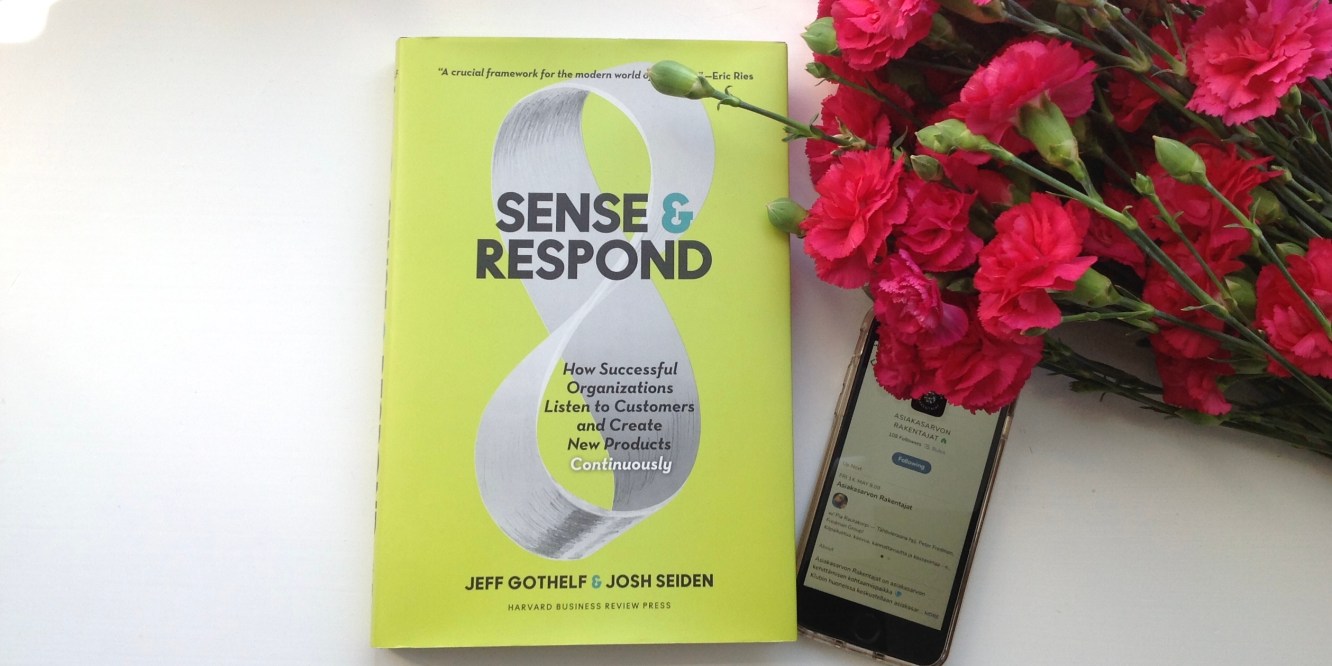
Sense & respond, a classic book by Jeff Gothelf and Josh Seiden, came into my mind when listening to a conversation in Clubhouse’s club for Building customer value (Asiakasarvon Rakentajat) hosted by Pia Rautakorpi. Sense & Respond is all about customer value and continuous learning, so about understanding the unexpressed and unmet needs of the people who are using the products and services. The same mission is in Clubhouse’s club for Building customer value. First few words about Clubhouse.
Clubhouse is an audio service or a social networking app based on audio-chat, launched in 2020 for iPhone and coming soon for Android. I feel that Clubhouse tackles some of the issues with building a perfect customer experience quite well. One of the key things is to find the right customer context for the user, so the right moment, mood, device, and need for the service to name a few. For me, the Clubhouse’s Building customer value -clubs conversations on Friday mornings have been a match. On Friday mornings at eight o’clock, I’m drinking my morning tea and doing my make-up, and it’s handy to listen to the conversations and not to watch anything.
There is a feeling of uniqueness because conversations are live sessions, just two people talking casually. Most importantly the conversations are from a specific area enough to fit my interests. Usually, I don’t have the patience in the morning to listen to generic conversations from the radio, and instead, I easily turn to music or choose silence.
These conversations about Building customer value I find myself coming back to. I have been contemplating customer contexts and customer needs also in my previous job, here is an article, so I find the topic to be very relevant. Audio for sure has so much more potential and it feels new openings like Clubhouse are very much needed to get the business to the next level.
In one of the Building customer value -clubs’ morning’s there was Mikko Ampuja talking about Vapaus.io, firm building mobility as a service and company bicycle -service, and the importance of the customer experience right from the start of the company. Vapaus is in an acceleration phase now, and there is a lot of customer feedback flooding in.
Prioritization is the most important, says Mikko Ampuja, and only two things can be improved properly at once. If there are more on your plate at once, it’s still so that only two are taken care of properly. And if there are a lot more things under construction, nothing is taken care of properly. That brings us back to what Gothelf and Seiden are writing: “Do less, more often”.
On another morning Peter Fredman from the Fredman group was talking about how they have changed the whole company culture to be customer-centric. It has taken time and patience, but the change has been inevitable for building new types of service business. In the transition technology is important, but customer value is more important. Customer value should affect all the layers of the work and all the layers of the company.
As Gothelf and Seiden are saying: “You need to embrace collaboration deeply and break down walls where you find them. This means that we need to consider how we organize our teams, our departments, our programs, and our initiatives.” Fredman group has done a lot with its people to improve sustainable development in foodservice, with building intelligent kitchens, and with efficiency by automatization and digitalization. The concept of a kitchen evolves, food delivery expands, and so on, and the development is done with the customers and end-users.
Gothelf and Seiden list seven building elements that make up a learning culture, and I feel the list is very relevant: Humility, permission to fail, self-direction, transparency, a bias towards action, empathy and customer value, and last but not least collaboration, diversity, and trust. This list has so many deep meanings that one can be overwhelmed with it. On the other hand, these things we are applying in our everyday life all the time when paying attention. We just need to get better when doing so. Doing less, more often.
I feel that there are quite many companies still that actually don’t put so much effort into customer value, or that an average person in the company thinks about customers maybe once a month in a workshop or when listening about successful customer cases. The question is do we start our day by thinking about how might I change the way that I do my job today to improve our customer’s lives?
“Everyone must have a sense of what your customers are trying to achieve, what’s getting in their way, and how your solutions help them to overcome those obstacles. Customer empathy helps us find a path through uncertainty,” as Gothelf and Seiden write.
Let’s keep reading great classics, listening to inspiring conversations, and most importantly turn these insights into actions in everyday life for the benefit of our customers and users.
Clubhouse’s club: Building customer value (Asiakasarvon Rakentajat) on Friday mornings at 8
Jeff Gothelf & Josh Seiden: Sense & Respond. How Successful Organizations Listen to Customers and Create New Products Continuously. 2017
.

 Small experiments and inspiration