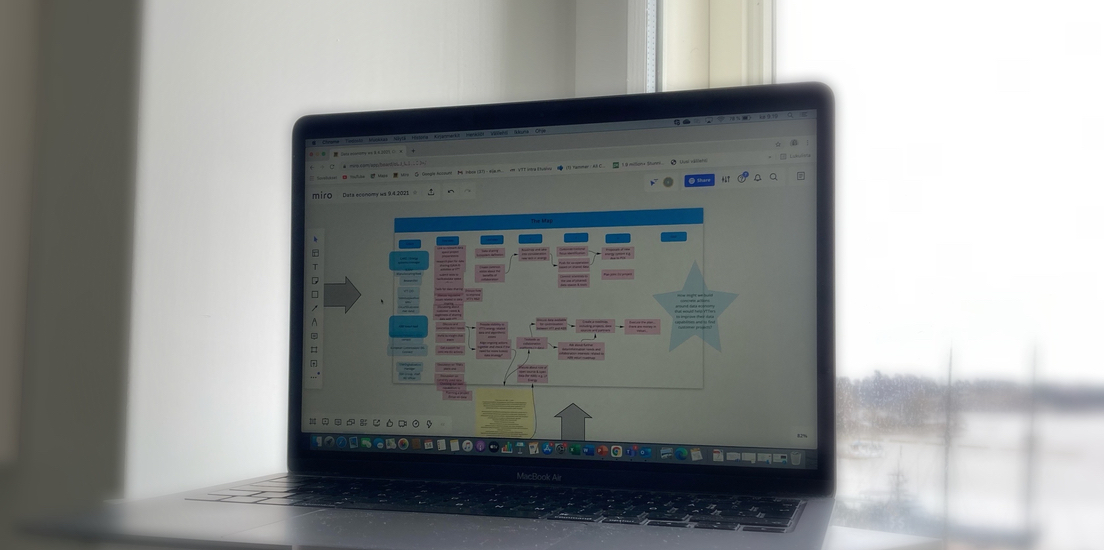
For solving complex problems you need focused time and a creative mindset. Design Sprint method, good preparation, and guidance from champions help enormously.
The original Design Sprint forces you to give your full attention for five days for solving your problem. The method can be used in product or service development, or for example when building a data strategy, where ever you can get benefit from seeing customer reactions beforehand.
The method squeezes the feedback loop very short, from idea to tested solution very quickly. The main idea is to concentrate on Monday to make a Map and choose a target, on Tuesdays to sketch competing ideas, on Wednesday to decide the strongest idea, on Thursday to build a realistic prototype, and on Friday to test it with target customers.
The Design Sprint can help you profoundly if you have the full five days. But what if you only have one day or even less? This is a short story of experimenting with Design Sprint day one “Monday” only in three hours, but first few words about the method.
The creator of Design Sprint Jake Knapp provides thesprintbook.com detailed information about the method, how to pitch Design Sprint, and for example 90-second video. There are wonderful illustrations, guiding questions, and even detailed checklists with timetables in this brilliant site and of course all of them in his book.
I’ve learned a lot from Jake Knapp’s videos and materials, but more importantly, learnings are from 8-bit-sheep’s design thinking and digital wizard Sami Kallinen. Sami has opened up the beauty of the method in many ways, but most importantly I’ve been able to do Design Sprints with him. Learning by doing is my thing, and I feel fortunate that I’ve had a champion. Data videos are one example of a consequence of a Design Sprint with Sami Kallinen.
This spring at VTT I’ve been chewing over the ambiguity of the data economy and what it can be in a variety of concrete actions. I felt we could go further with the existing ideas by co-creating with nearby brilliant people. Sami Kallinen suggested I experiment the day one of Design Sprint to get some new perspective of the challenge.
I asked seven people from different backgrounds and teams to take part in this experiment, the decider, a qualitative user research expert, a person with international excellence of the topic, someone outside the box, and so on. We only had one afternoon for day one “Monday”, so for refining the Challenge that we would be solving, making the Map, and choosing the target.
Before the experiment day, I send some background information about data economy findings that had been done previously at VTT and about Design Sprint as method. I also send the first version of the Challenge and asked people to think about it before. I felt that people came well prepared and we could start working together very quickly in Miro, which is an online visual collaboration tool.
After a short welcoming and introduction on Design Sprint, we followed Design Sprint day one in quite a systematic way. First, we reviewed the Challenge by giving two minutes to each participant with the help of Miro’s Timer. Then came individual work and post-its about the Optimistic scenario, and after that sharing and using a simultaneous grouping of the post-its. And then the same steps with the Pessimistic scenario.
After that was the most important part, forming the Map. Identifying the user was harder than I had suggested earlier. In previous Design Sprints, it had been fairly easy to identify the end-users and customers, but since there is such a wide collaboration between different stakeholders at VTT it turned out to take more time than I had expected. Luckily the decider Kalle Kantola had a great suggestion on how to narrow down the possibilities in this experiment, and we could move on.
It’s quite often the case that some phases take more time than you expect. That’s why it’s very important that you prepare yourself with at least a couple of variations of the plan. You have to decide beforehand what things you absolutely can’t skip if the timetable falls apart. Preparation beforehand can’t be emphasized enough.
Asking guidance from others always helps when planning new experiments. Sami Kallinen was kind enough to give me some excellent points on how to squeeze things into a very tight timetable. I’ve also learned from Sami years ago already, that minute by minute timetable is a must in all workshops and facilitation.
We only had one interview in this experiment because of the timetable, even there are usually several on Design Sprint Day one. Luckily interviewee was very quick-witted and the rest of the group was able to make a good amount of How Might We -post-its. And because this last phase was quicker than normal, we had a nice time to group and prioritize How Might We -post-its into themes and summarize future steps.
Work with identified users, first and following steps and prioritized themes will continue in multiple ways. Let’s see if we will want to carry out the following days of the Design Sprint with some of the people as well. Also, legal design is needed around data economy and data sharing, where we can benefit a lot from design methods.
I would be happy to hear from your experiences if you have done only parts of the Design Sprint or a shorter version of it. Please send me a message on Linkedin, Twitter, Instagram, or here. Thank you for reading, the journey with experiments continues.

 Small experiments and inspiration
One Reply to “Experimenting Design Sprint day one as solo”