End-user insight is crucial in all development, also when developing leadership. Focusing on positive outcomes will bring solution-oriented results.
It was the second week in my new job when I got the chance to participate in leadership development at VTT. It was part of VTT’s New work -program and I was invited to facilitate a workshop after a couple of weeks.
I instantly thought of Bright Future and how it could help also in leadership development. Bright Future is a method that was developed by Mirette Kangas and is part of constantly developing Yle Lean Culture Toolkit. I have been fortunate enough to be able to participate in several Bright Future workshops in my previous work and have also been using the method myself.
Bright Future has its roots in Dave Gray’s The Culture Map which has inspired people all over the world. Bright Future has clear phases and focuses on positive outcomes so I thought it suited better than The Culture Map for this use case. Neither of the methods is especially for leadership development, but I wanted to experiment if it would work. Customization was fairly easy to do because of the experience of the method.
The first workshop was held as a normal face-to-face workshop since Covid-19 was in October at a steady stage in Finland. We used masks and held two-meter distances, but oh boy it was lovely to see people live! Especially since I had never seen most of the participants except online.
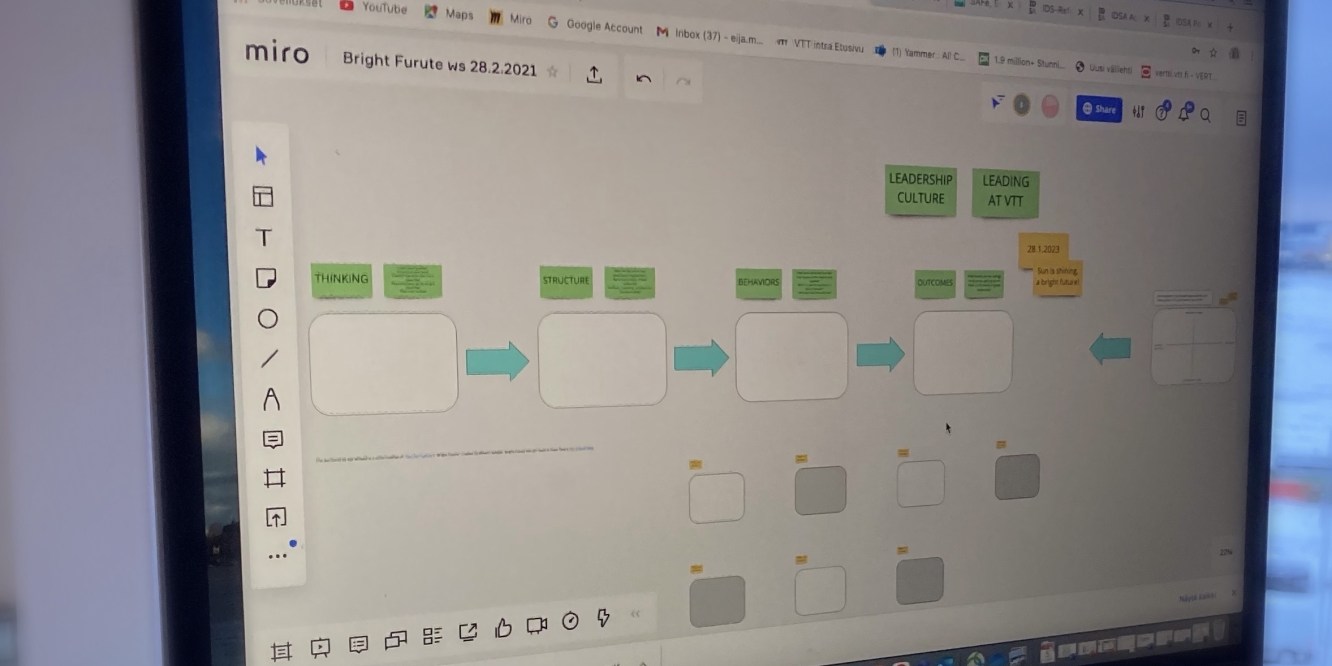
Bright Future starts with Outcomes that the participants see in two years. Everything is clear and the sun is shining for excellent leadership, as the Bright Future name tells. From there it rolls back to Behavior, Structure, and Thinking needed on the path to the Bright Future. Phases and guiding questions help people to think in concrete terms, but also focuses on things needed to be developed to succeed in the future.
In the first workshop with development professionals came the idea of extending the experiment to two more groups. The second workshop was in January with a group of experts from different sectors of the company. These experts can be seen as the end-users of management-level leadership, but also as leaders when leading yourself. The third workshop will be with the management board later in the spring.
The first two workshops show interesting differences already. The expert group was more concrete and they focused on impacts of leadership close to everyday work. Both groups were solution-oriented, most likely thanks to the method itself, but the second group was even more than the first one. They emphasized for example the importance of participation, interaction, continuous feedback, and valuing individuals.
The second workshop was held remotely and by using Miro. It was very nice to see that the enthusiasm was as strong as it was in the live version, even when we couldn’t meet face-to-face. I tried to keep the set-up as same as possible. For example, participants had two-minute time-slots when presenting their post-it’s as in the face-to-face workshop. Miro’s timer works quite optimally, people can see it, but it’s not too disturbing.
For creating new post-its I made separate areas for each participant, in the same way as they had their tables in the live workshop. The difference came when moving the post-it’s to the joint area, it wasn’t sensible to move them one by one like in a live situation. Easier was to explain one’s selected post-it’s in the own area and then move all these selected post-it’s at once to the joint area. Luckily there were clever participants to suggest this. Archive area was also needed for all leftover post-its after each phase.
From the facilitator’s point of view, it’s very handy that all post-its are in digital form straight away when using Miro. In the best-case scenario, some post-its and experimentation ideas could be copied after the workshop to leadership kanban with swimlanes to support actions needed.
I’m very pleased that the New Work -program at VTT is encouraging experiments. Hopefully there will be a Bright Future in leadership in a concrete way after two years, as in the method is suggested. I would be happy to hear from your experiences in using The Culture Map or the Bright Future in different contexts and sharing thoughts on how to develop workplaces and leadership for the better with them.

 Small experiments and inspiration